
DEAR MAYO CLINIC: My older sister was recently diagnosed with thickened heart muscle, and her doctor recommended a procedure called a "septal myectomy." I’ve never heard of it before. What does this surgery do, and how do doctors know when it's the right treatment?
ANSWER: Hearing that someone you love may need heart surgery can be scary, especially when you're also trying to understand an unfamiliar heart condition. Treatment usually starts with medication. However, for some people, surgery becomes the best option when symptoms continue despite medical therapy.
Your sister's condition is called hypertrophic cardiomyopathy, or HCM. It's a relatively common genetic condition that affects about 1 in 500 people. It causes the heart muscle to become abnormally thick, most often in the wall between the heart's two main pumping chambers. As a result, the normal pathway where blood leaves the heart can become blocked.
HCM can affect the heart in two ways. The muscle may become obstructive from the thickening, or it may become stiff. Both forms can cause symptoms such as shortness of breath, chest pain, fatigue, low energy and reduced endurance. The obstructive form caused by the thickened heart muscle is the one that surgery can often correct. Most people with HCM have this type, which is why septal myectomy can be an effective treatment for appropriately selected patients.
Doctors usually diagnose HCM with an echocardiogram, an ultrasound that lets them see the heart and measure the thickness of the heart muscle. Because HCM is a genetic disease, blood tests can identify some genetic mutations. However, not every mutation can be detected with a blood test, so imaging remains the primary way doctors diagnose the condition.
Treatment
Treatment usually begins with medications such as beta blockers, calcium channel blockers and newer medicines called myosin inhibitors to help manage symptoms. Surgery is rarely the first treatment that is recommended. Instead, it is considered when symptoms continue despite medication or when patients are not able to tolerate their medical therapy. That's why deciding whether surgery is the right treatment depends not only on the diagnosis but also on how well symptoms respond to medication. A cardiologist experienced in treating HCM can help determine when it's time to consider surgery or another form of septal reduction therapy called alcohol septal ablation. During this procedure, a small amount of alcohol is delivered through a catheter to shrink a portion of the thickened heart muscle and improve blood flow. In general, this procedure is reserved for patients who cannot undergo surgery.
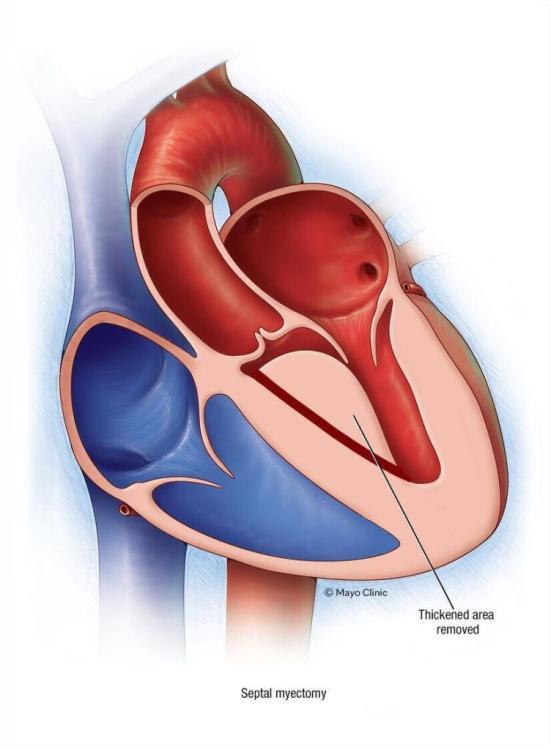
A septal myectomy is an open-heart operation that removes the portion of thickened heart muscle blocking blood flow. During the procedure, echocardiographic imaging helps surgeons identify where the muscle is thickened. Afterward, imaging confirms that blood flow out of the heart and the function of the heart valves have returned to normal.
Like any heart operation, septal myectomy has risks. When it's performed at a center with expertise in this procedure by an experienced surgeon, the risk of death or a major complication like stroke is less than 1%. Another possible complication is the need for a pacemaker because the area where the muscle is removed is close to the heart's electrical system; in specialized centers, this is usually less than 2%.
After surgery, most patients stay in the hospital for about five days. Recovery takes about six to eight weeks. During that time, patients are encouraged to stay active by getting up, walking and moving around. The main restriction is avoiding heavy lifting until the breastbone heals. By two or three months, many people can return to activities such as exercising, running and weightlifting.
One of the biggest benefits of the procedure is a significant improvement in quality of life. People who were limited by their symptoms before surgery often are able to return to the activities they enjoy afterward. Many patients need less medication after surgery, and others no longer require it. Growing evidence also suggests surgery may help people live longer than medication alone.
Because HCM is a complex disease, experience matters. Patients considering septal myectomy should feel comfortable asking where the procedure will be performed and how much experience the multidisciplinary care team has treating HCM. Centers with expertise in HCM use a multidisciplinary approach, bringing together cardiologists, surgeons, imaging specialists, genetic experts and other specialists to determine the best overall treatment plan for each patient.
Joseph Dearani, M.D., Cardiovascular Surgery, Mayo Clinic, Rochester, Minnesota